A new look at local art within Edmonton. I will be regularly blogging about a different work of art within the city. The pieces are works decorating Edmonton and will always be free to access. Check them out yourself and comment on the blog about your own thoughts!
Monday, 15 September 2014
Holly Newman, Untitled
Artist Info: Holly Newman is an Edmonton-based artist who has been involved in the local art scene for over 30 years. Newman graduated from the University of Alberta in 1985 with a BFA and has since taken part in numerous group and solo shows including exhibitions at Harcourt House, the Art Gallery of Alberta and The New Gallery in Calgary. No stranger to public art, she was commissioned in 2006 to create the work 'I Witness' at the Health Sciences LRT station. According to her website, Newman's work revolves around the city landscape and the glimpses of nature we can catch while exploring Edmonton (if we are careful enough to notice!).
The work featured here is a series of granite benches situated along both sides of Jasper Avenue between 102 and 100 Streets. The benches have images and text etched into their surface, referencing the changing of the seasons and the various natural phenomena one can see during the year. The work is a Percent for Art Commission through the Edmonton Arts Council and was completed just a year ago in the fall of 2013.
My Thoughts: As I am sure you have picked up by now, I love interactive art! Therefore, I have been a fan of this work since I first noticed it along Jasper Ave. I love the juxtaposition between the natural imagery on the benches with their location in one of the most metropolitan parts of Edmonton. Being someone who also obsesses about the minutes of daylight, the migrating geese and the changing seasons, I find myself very moved by Newman's descriptions of nature in the city. The piece serves as a reminder to look around you while waiting for the bus or walking to work.
On that note, I was just wanting to let you all know that this will be my last YEGallery posting. As I'm sure many of you have noticed, my time and dedication to the blog has been waning in the past few months. I've been struggling to keep things fresh and find accessible works of art that I find interesting. After some months of deliberation, I have decided to end the blog. When I started it up I wanted to continue it for at least a year and I have successfully accomplished my goal. To anyone reading this - thanks for investigating Edmonton public art with me. I'll be keeping this blog up as a resource to anyone wanting to learn more about a particular piece. Send me a message if you have any questions or comments! Thanks!
Sunday, 27 July 2014
Deborah Butterfield, 'Whistlejacket'
About the Artist: Deborah Butterfield is an American sculptor
who graduated with a BFA in ’71 and a MFA in ‘73 from the University of
California, Davis. She is best known for her horse sculptures made of scrap
metal and wood. Butterfield said she had originally wanted to her subject
matter to feature the female form but found too many of her contemporaries
taking a similar focus. Instead, she chose to use horses as a kind of
self-portrait. She has since been working almost exclusively in the equine form
since the 80s. She divides her time between time between homes in both Montana
and Hawaii. She only creates art during the winter, meaning each piece can take
a number of years to create. Some of her most stunning works are made of bronze
casts of branches, resulting in the appearance of wooden sculptures with the
durability of metal.
‘Whistlejacket’, created in 1988 of welded scrap
metal, sits tucked into a small green space between the plaza shops on Jasper
at 112 Street. Looking at old auction records, the work appears to have been
purchased in 1994. It had previously been seen at a commercial gallery in New
York City. The name ‘Whistlejacket’ likely relates to the famous painting of a
racehorse owned by the British Marquess of
Rockingham in 1762. The work was created by George Stubbs,
a painter of the period best known
for his portraits of horses.
My Thoughts: Being a
rider myself, this was one of the first sculptures I really noticed when I came
to Edmonton. That being said, I have had a hard time knowing what I think about
this sculpture. Standing so close to Joe Fafard’s life-sized bronze horse, I often find this horse looks skeletal. Furthermore, the stance of the
animal does not make it look happy or friendly. Butterfield is known to have
said her ‘horses' gestures are really quite quiet, because real horses move so
much better than I could pretend to make things move. For the pieces I make,
the gesture is really more within the body, it's like an internalized gesture’.
Unfortunately, I struggle to see this internal commentary in the rusted scrap
metal. While I enjoy the opportunity to see my favourite animals featured in a
public artwork, I find this piece does not speak to me in the same way as her
wooden or bronze sculptures.
What do you
think? Can you read more into the horse’s emotions?
Sunday, 25 May 2014
Marc Boutin, "Memoryscape"
About the Artist: Marc Boutin is the founder and head of the Marc Boutin Architectural Collaborative in Calgary. The 7 person collective is interested in blending art, architecture and urban design into their creations. Their work has been applauded both internationally and abroad and they have received numerous awards including the Architecture Award from the American Institute of Architects and the 2002/2003 Prix de Rome in Architecture. Boutin also works as a Professor of Architecture at the University of Calgary where he states he is passionate about "the intersection of teaching and research as practice."
"Memoryscape" was completed in 2013 as a commission by the City of Edmonton. The City worked with the Edmonton Arts Council to select an artist best suited for the work. The piece was created in tribute to the many military families living in and around Edmonton. Boutin said he wanted the piece to discuss the story of the soldier as both a peacekeeper and as a key figure in his or her local community and home-life. The piece consists of 9 steel boxes of varying size with perforated holes creating an image of Canadian soldiers and their families. The site for the work, situated at the back of City Hall on 104 Ave, was selected because it is the route soldiers take when they leave and return home from service.
My Thoughts: I noticed this work for the first time a few months ago and was curious what sort of story it was trying to tell. I like the fact that the work is dedicated to the dual life led by military soldiers at home and on tour. Being located at City Hall, particularly where it can be easily seen by the military, is also appropriate because of the large number of military-related events and ceremonies that take place at City Hall and on Churchill Square. That being said, I wish the work had been placed in a larger green-space, perhaps in the large front lawns of City Hall of the Square. Being tucked right next to the large building means the work is dwarfed and often missed. Also, I think the drilled holes and textures in the steel would look interesting in the sunlight. Unfortunately, due to the location of the piece, it only receives shade for most of the day.
Sunday, 4 May 2014
Neon Sign Museum - 104 St and 104 Ave
The museum is a result of a partnership between the City of Edmonton, the Alberta Sign Association, Telus, The Places and the Downtown Business Association. The project has been in the works since 2008 as an element of the 104 Street revitalization project, helping to return the industrial heritage area into a local hotspot. The goal of the museum is to encourage residents to visit the museum and talk to each other about the history of the city and the development of the downtown core. The city is hoping the museum will grow beyond its current display. There are plans to refurbish the remaining 4 signs and the city has put out a call for the donation of more heritage signs in the hope that they will be able to add to the gallery in years to come.
My Thoughts: There are few things I love more than turn-of-the-century industrial architecture. 104th and the surrounding streets are my favourite part of the city. Being able to see little tidbits of history hidden in with the contemporary buildings always feels like finding a hidden treasure. As a result, I was so incredibly happy when I saw this project being finished back in February. It can sometimes feel like history is hard to come by in a boom town so the effort to recognize some of the companies that helped to develop this city 100 years ago allows viewers to see Edmonton's development as a liner progression through time. Also, I really appreciate the full detailing of the history of each sign on the City's website. Not everyone has access to grandparents or other elders who grew up in Edmonton to tell them about each company. The site helps to turn the site into a functional, educational museum instead of just a novelty.
What do you think? Do you love this new sign project as much as I do? I am curious to see if the city adds more signs to the museum!
Sunday, 30 March 2014
Aaron Paquette and Sylvie Nadeau, Untitled
Nadeau mural (left side)
Nadeau mural (right side)
Original Nadeau mural (centre)
Full Paquette mural
Paquette mural (left side)
Paquette mural (centre)
Paquette mural (right side)
Artist Info: Aaron Paquette is a Metis artist who lives and works in the Edmonton area. According to his website, he is a painter, writer, keynote speaker and workshop facilitator. He acts as a mentor artist as well as an activist and First Nations representative for the province of Alberta. His training is not actually in painting but in the creation of stained glass windows and metal work. This background as a goldsmith is apparent in the metal details in the mural.
Sylvie Nadeau is a Quebec-born artist who has been residing and making work in Edmonton since the 80s. She completed degrees in Fine Art at Laval University and Arts Education at the University of Alberta. Nadeau completed the original Grandin Station mural of Bishop Grandin 25 years ago. She was invited to return and complete a second mural with Paquette to discuss the controversy of the original mural.
The original Grandin mural was created in 1989 and was a memorial to Bishop Grandin who played an active role in the early development of the area. The work became very controversial after its creation because of the role the bishop played in the creation of the residential school system in Alberta. Nadeau said she was unaware of the controversies when she painted the work and saw the piece as being about "love, compassion, learning to live and build in harmony together". Nevertheless, she has received much criticism about the piece due to its connection to Canada's painful history in the residential schooling system. As a result, she was eager for the opportunity to add to the mural and change the tone from something about darkness to a more hopeful outlook. Nadeau added a panel to either end of her original mural. The scenes show playful aboriginal children with First Nations symbols and icons in the background, showing the children's link to their culture.
Facing the Nadeau mural is Paquette's 80 foot work. Paquette talks about his opinions of the original mural as a child in saying that he had liked the Grandin mural because it reminded him of his ancestors as the first people to live on this land. As he grew older and learned about the history of the residential schools he began to associate it with a painful chapter in Canada's history. He, just like Nadeau, was happy for the chance to continue the dialogue and make the station about celebration.
On his mural Paquette painted both aboriginal individuals and a number of animals. In his statement about the work he identified that each one of the animals has a very important symbolic meaning; the white buffalo represents peace and hope, the wolves discuss family and a connection to the land, the bears are about healing and the raven represents a teacher and a connection between both life and death. The piece discusses the 10 000 year history of people on this land.
My Thoughts: I had actually written a blog post about the original Nadeau work in the summer but had deleted it before it was posted. I wasn't sure what I thought about the piece. I clearly saw the connection to the residential schooling system in the mural but did not want to blame Nadeau who said it was not her intention to bring up painful memories in the piece. I didn't know what tone I wanted the post to take so I deleted it before it was finished. As a result, I was very happy when I heard that the controversial piece had been added to and could not wait to make it the next blog posting. I love the bright colours and gold details in the Paquette work. In one of his statements he talks about going down into the dark cavern of the station as a journey to discover a secret or story . I can definitely see through the mood of his piece that the story is now one of healing.
I have added many photos to this post. Both of the Paquette piece and of Nadeau's mural. I apologize for the quality of the photos. To protect the works from the LRT the murals are now covered in glass. Unfortunately, the overhead lights in the station reflect off the glass making it hard to photograph the work. Also, being so long, the photos all come in parts. I really recommend you going to the station yourself to check out this beautiful work. There are also a ton of great photos of the mural's installation in this Edmonton Journal blog: http://blogs.edmontonjournal.com/2014/03/17/2o14-o3-16-grandin-stations-conversation/
Finally, I just wanted to let you know that blog posts will be coming slightly less frequently. I have become very busy over the past few months and have been struggling to find time and motivation to keep posting. I do still want to continue the blog but will probably drop down to only posting about once a month instead of every two weeks. If you want to keep seeing posts send me a message! I'd love to hear from you.
Friday, 14 March 2014
Zoe Bacchus, Sherri Shorten and Harold Wollin, 'Sway'
Artist Info: The latest work on the blog is a compilation by three different individuals from varying backgrounds. Zoe Bacchus is a Masters student at Concordia where she is researching the effects of sound on the brain. Much of her work involves the connections between sound and art and how they affect one another. She is not a stranger to art collaborations and has worked with other artists to create pieces for public, private, corporate and non-profit businesses. Sherri Shorten is a Edmonton-based architect who has made her career creating a number of private, public and tourist structures. She is also passionate about art and works as an artist on the side to create her pieces for sale at local galleries and markets. Finally, Harold Wollin is an owner a chef at the Blue Chair Cafe in Edmonton. He completed his degree at NAIT in culinary arts and has travelled all over the world where he picked up different cooking styles from a multitude of cultures. Beyond his career in the kitchen he is also a musician and an artist.
'Sway' is a 12 foot by 20 foot mosaic on the side of the Arts Habitat building at 102 Avenue just East of 106th Street. The mosaic is made up of over 12 000 ceramic tiles depicting an elm tree. According to The Places website, the elm tree is supposed to represent the harmony and connection between all three of the artists as well as the city of Edmonton itself as a major arts centre in a unique, northern location. The piece was a 2001 commission by The Places for the Edmonton Business Council for the Visual Arts.
My Thoughts: I was intrigued to learn about the elm tree as a symbol to represent all of the artists since I was definitely surprised by the differing backgrounds of the three contributors. I would like to know more about how they see the elm as a symbol and what sort of collaborative process they went through as artists to create the piece.
I pass this work a few times a week and so I have had the opportunity to see it at all times of the year. I find I enjoy the piece much more in the summer than the winter. A major reason for this might be the colour scheme. During the winter the building and parking lot around the work is incredibly grey. I find the reds and oranges in the tiles are not particularly vibrant (perhaps due to sun fading?) so they do not jump out at me or contrast against the grey surroundings. In the summer, when the area is green, sunny and colourful, I find I enjoy the navy blue tiles which have maintained their vibrancy and provide a nice contrast to the bright surroundings.
In whatever season, I still do like this small reference to nature in between all of the buildings of 102 Ave. What do you think? Have you noticed this work seems different with the seasons?
Friday, 21 February 2014
Catherine Burgess and Sandra Bromley, 'Big Rock'
Artist Info: Catherine Burgess has already been featured on the blog back in June for her sculpture 'Return'. For those who are not familiar with her work or the previous post, Burgess is Alberta-born and attended the University of Alberta where she focused in sculpture. She is best known for her steel sculptures, many of which are scattered around the city and university campus.
Burgess completed 'Big Rock' with Sandra Bromley, another Canadian artist. Bromley also graduated from the U of A and has been recognized for her work both as an artist and with humanitarian aid efforts. She is probably best known for her massive work 'Gun Sculpture' which she completed with Wallis Kendal. The work is meant to discuss war, violence and black market weapons trafficking. Bromley is also known around Edmonton for her role in developing the iHuman Youth Society - a group that works with high risk youth to teach and create art.
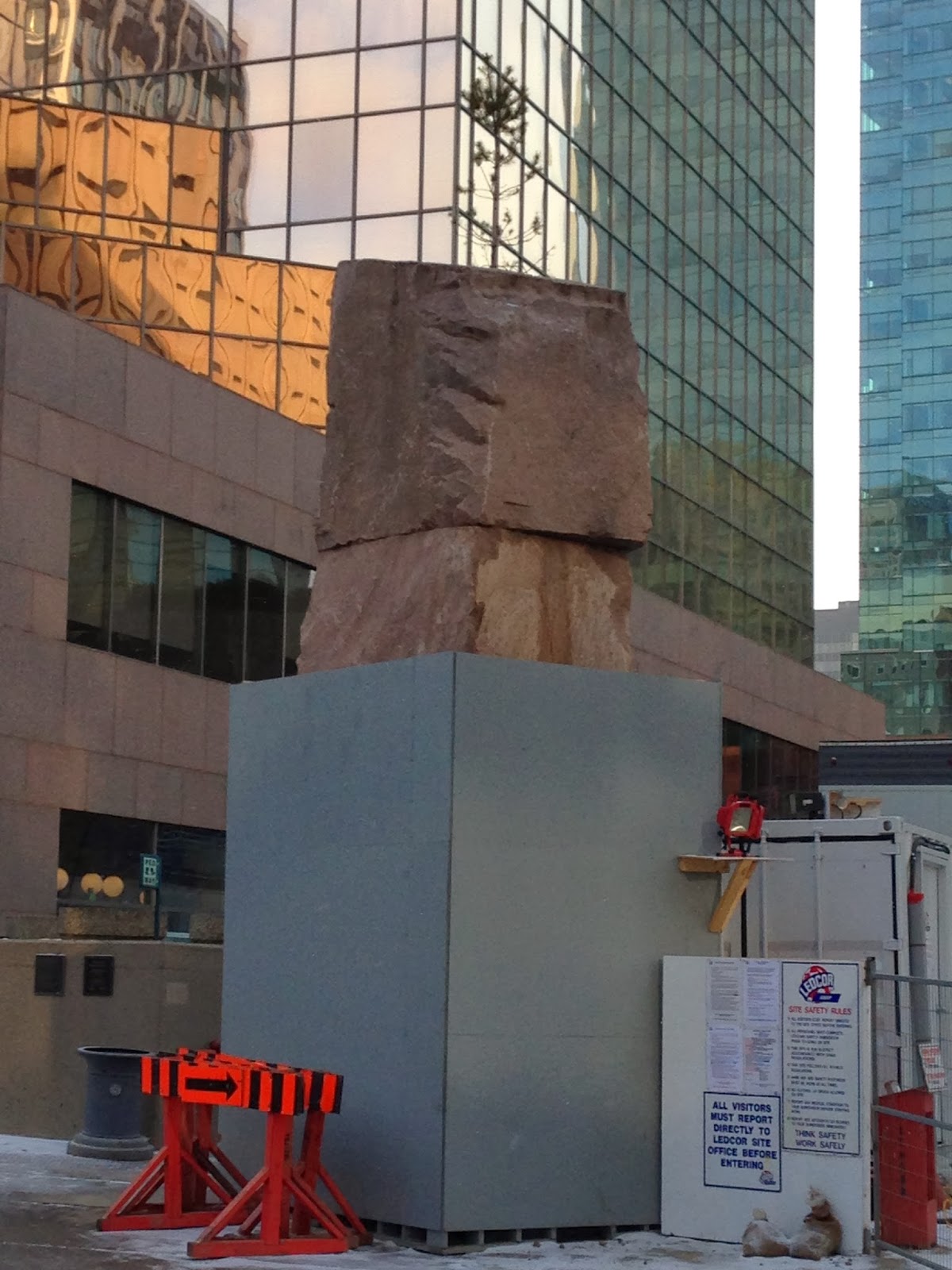
'Big Rock' consists of 62 tons of granite with a living tree on top and sits at the intersection of Rice Howard Way and 101A Street. The work was a commission from The Places in 1995. According to The Places website, the artists worked with a geologist and searched all over the country to find just the right piece of granite. Once they had found the rock, it was blasted out in 3 parts and shipped to Edmonton.
My Thoughts: I had been planning this blog post for a while so you can imagine my frustration when I walked up and saw that it is half-covered because of the nearby construction!! I have included my photo as well as a photo of the full work from The Works' website. (photo credit below). Still, it is interesting to see how it is being protected. A great example of public art conservation in action!
I have always been drawn to this work and am happy it is finally featured on the blog. I find the historic-looking stone matches well with the cobblestone road and heritage buildings along Rice Howard Way. Also, I like the inclusion of the small tree on top of the rock. It makes me think of a small piece of nature nearly lost within the infrastructure. It also reminds me of the wind-blown pines growing out of the rock on the Canadian Shield.
Unfortunately, I don't know much about the artists' inspiration for this piece. If you have any information, please post it to the blog!!
* Photo credit: http://www.theworks.ab.ca/placesfolder/tour/pages/001.html
Tuesday, 4 February 2014
Laurent Grasso, 'Soleil du Nuit'
Artist Info: Laurent Grasso is a French artist who bases his practice out of both Paris and New York. He completed his schooling at the École Nationale Supérieure des Beaux-Arts in Paris and has since been recognized for his achievements in the art world. Grasso has shown his work at numerous exhibitions around the world and has participated in a number of international biennials. In 2008 he was awarded with Prix Marcel Duchamp for his work in the field of conceptual art. Many of Grasso's works revolve around his interest in studying science and history.
'Soleil du Nuit' was opened just a few months ago, in the spring of 2013. The work sits in two parts - a series of three rotating metal balls right outside the entrance to the Commonwealth Rec Centre and a neon light sculpture with the words 'Soleil du Nuit' close to another nearby parking lot. Unfortunately, I wasn't able to see the neon lights when I visited this work but I included a link at the bottom that contains TONS of images of this piece. The artwork is supposed to be about the varying amounts of light we get during the summer and winter months, particularly touching upon the small amount of daylight we get during this time of year. The rotating balls are intended to catch the light and create a shimmering, disco-like effect. The work uses the natural light during the day and is electrically lit at night. Grasso mentioned that he hoped the work would catch the eye of a passersby and they would be led by their curiosity to inspect the work further. Grasso also mentioned that the light-catching balls are supposed to reference early Canadian settlers who used mirrors to communicate to each other across large distances.
The work has been somewhat controversial since its installation. Just like the Talus Dome, some individuals are upset that the commission was given to an international artist instead of a local. According to the Edmonton Arts Council the work was selected by a panel out of many pieces. They selected the work because they liked the idea behind the piece and thought the international status of the artist would give a global feel to the city.
My Thoughts: I am quite drawn to this work. I had been told about the 'lollipop sculpture' but did not know the name of the piece and could not figure out where it was in the city. I was definitely excited to stumble upon it while heading to the rec centre last week! I remember walking up to the sculpture and being unsure if the work was actually moving. I stood still for a few seconds and was pleasantly surprised to find that the work itself slowly rotates! I have visited many pieces since starting this blog and very rarely get to see a moving work in action.
I know this piece has been controversial because the artist is from France. While I understand the argument to give commissions to local artists, I do tend to agree with the EAC in the importance of including international artists to give the city a global feel. The city is becoming a large, world-recognized destination. It is nice to be able to show that we are welcoming to outsiders as well as our own artists. Furthermore, showing we support international art is the only way to have international cities support our own artists.
What do you think? Do you like this piece? Do you agree or disagree with my argument in support of international art?
Here is this link mentioned above with additional images of the artwork: http://blogs.edmontonjournal.com/2013/06/10/2o13-o6-1o-day-for-night/
Thursday, 23 January 2014
Ray McAdam, 'Passengers'
Artist Info: Ray McAdam is an active artist and art instructor in Edmonton. He received his Bachelors in Design at the University of Alberta and has taught design courses at the university since his graduation. He also works at Grin Design House where he receives contracts for visual media such as posters or advertisements. According to his bio on the Grin webpage, he specializes in CAD 3-D modelling which he uses to create sculptures out of metal, plastic and wood. He also enjoys using his design background to renovate buildings within the city.
'Passengers' was created in 2009 as a Percent for Art commission at the South Campus LRT station. The work consists of clear, plastic bird silhouettes flying under the roof of the LRT station. The birds also contain LED lights so they can be lit when the station is dark. According to the Edmonton Arts Council report, shortly after the sculpture was installed a few of the birds became damaged and fell down from the ceiling. The entire sculpture was removed and the birds re-secured. It was re-installed in the summer of 2011.
My Thoughts: I had never noticed this sculpture in-person before but had seen information about it online wanted to feature it on the blog. I am usually very drawn to birds in art so I headed to the LRT station expecting to be attracted to this work. Unfortunately, I was a little disappointed with the sculpture. I thought the shapes didn't like birds at all! The silhouette I had been looking forward to seeing reminded me more of a manta ray than a bird. I believe this simplified shape was an attempt on behalf of the artist to get away from the typical bird silhouette used in glass transit stations to frighten away actual birds. Still, I thought a lot of the magic was lost because the shapes did not look like birds. Perhaps if I had seen the work with the LED lights on I would have had a different reaction, but overall I left feeling a little disappointed.
I also wanted to include images of the actual bird-scaring devices at this LRT station so you can see how the objects work together. (shown below) Even though I was disappointed with McAdams birds, I still enjoyed the bird theme going on at the station. Both the sculpture and the functional balls help to make the station seem a little less urban and tie in with the U of A experimental farm visible from the station.
What do you think? Am I being too hard on the birds? Do they look different when they are lit? Maybe it was because I had gone to the station with a pre-concieved idea of what I was going to experience.
Tuesday, 7 January 2014
Tommie Gallie, 'Hidden Charms'
Artist Info: Tommie Gallie is an Edmonton-based artist originally from Nova Scotia. He completed a degree in Fine Art at the Nova Scotia College of Art and Design in the late 60s and continued on to receive his MFA at the University of Alberta in the early 70s. His earliest sculptures often used wood in conjunction with ropes and tar to reference his Maritime heritage. His interest in wood as a medium continued and the majority, if not all, of his later sculptures were made almost entirely out of varying types of wood. Apparently, he often uses smaller pieces of wood to secure the larger sculptural elements together, using balance and pressure instead of nails to create the desired effect. Most of the pieces are site-specific and have been built into a specific location.
'Hidden Charms' was part of a commission from The Places in 1978 when Churchill LRT station initially opened. It is made of both fir and hemlock woods as well as steel rods over the top of the sculpture. The work is tucked into a pedway alcove between the City Centre Mall and Churchill Station and was likely built on site, specifically for the dimensions of the hallway. Unfortunately, there is minimal information about this work or about Gallie's career as an artist. If you have any more information, please post it to the blog!
My Thoughts: I have always been undecided about this work which is why I have not posted about it until now. On some days I enjoy the brief reference to trees and nature in the unwelcoming and sterile pedway. Other days I find the work random and confusing. It doesn't seem to tell me a story and I wonder why it is there. In one of the few articles I found about Gallie I read that he sometimes created juxtaposition in his work through the setting and materials. I think there is a definite juxtaposition occurring here between the whitetile of the station and warm yellow wood in the sculpture. Nevertheless, I find the title 'Hidden Charms' very appropriate. The work cannot be seen from the curving pedway until you are right beside it, leaving an unexpected surprise when you finally get a glimpse of this large sculpture.
What do you think about this piece? Please do let me know if you have any more information about Gallie.
Friday, 20 December 2013
J. Steward Johnson, 'Lunchbreak'
Artist Info: J. Steward Johnson is a painter and sculptor born in New Jersey in 1930. In his early life he worked at the well-known company Johnson&Johnson, founded by his grandfather Robert Wood Johnson. He began focusing on his art career in 1962 when he was fired from his job at Johnson&Johnson by his uncle. His earliest artworks were paintings but he began to work almost entirely in sculpture by 1968. He has since become well known for his sculptures of every-day people. His works are largely public commissions and can be found in cities in the US, Canada, France, Italy and Hong Kong. He is recognized for the life-like poses and realistic-looking fabrics on his figures. To create his works, Johnson usually begins with a small clay sketch. He would then make a larger sculpture to form the mould. To create his realistic fabrics, Johnson would occasionally include real clothing items to shape the mould, thus creating the folds and textures in the final metal sculpture.
'Lunchbreak' was given to the City of Edmonton in 1983 as a gift by the Devonian Group of Charitable Foundations. The sculpture has remained a part of Churchill Square as the Square has developed from a grassy field to the concrete centre it is today. This is not the only 'Lunchbreak' sculpture to be created by Johnson. There are at least 3 other identical sculptures in the US. Interestingly, in doing some research on this sculpture I noticed that the lunch kit sitting on the bench occasionally changes. Sometimes he is only sitting with a lunch box while at other times he also has a thermos. I do not know if this was the intent of the artist or if the other items in the lunch kit have been stolen or damaged over time.
My Thoughts:
So far with this blog I have usually been trying to stay away from these figurative sculptures because I often find them too closely connected with monuments. Still, I know how beloved the 'Lunchbreak' sculpture is within the city so I wanted to include it in a feature on the blog. Johnson's sculptures have been criticized for being too kitsch and I definitely can agree with this statement. There is nothing challenging or thought-prevoking about this sculpture. Still, it is hard to dislike something that is so well recognized as a symbol of the city. Although the piece is 30 years old, I still often see people taking photos or posing with the figure. I also sometimes see it featured on the news or in advertisements about Edmonton. It has become one of the iconic symbols of the city and helps people to instantly recognize Churchill Square. Kitsch or not, I think it is definitely a key sculpture in Edmonton and will continue to live in the city centre for many years.
This will be the last blog posting for this year. Thank you joining me in 2013 as I wandered through Edmonton public art. I hope you all have a Merry Christmas and a Happy New Year! I'll see you in 2014!
Sunday, 1 December 2013
Inges Idee, 'Running Track'
Artist Info: This bright red sculpture is a creation from the artist collective Inges Idee. The piece was a Percent for Art commission for the new Terwillegar Rec centre and was installed in 2010. Inges Idee is a group based out of Berlin consisting of four artists - Hans Hemmert, Axel Lieber, Thomas A. Schmidt and Georg Zey. Each member of the group has his own art practice but they also work as a team to create public works of art. The artists mention that they like creating work for public spaces because it is constantly evolving as the neighbourhoods develop over time. They prefer these works in public spaces to the white cube of museums because they can become a part of the community and grow with the city itself.
'Running Track' is a huge foam sculpture measuring 5 metres high and 8 metres long. The work was created by Inges Idee in Calgary and shipped to Edmonton in two pieces. The work is coated with a strong, polyurethane paint. Not surprisingly, running track is supposed to represent two running legs. The artists took a sculpture of a running figure and broke the movements down into a more abstract essence of movement to create this piece. The piece is supposed to reflect the activities within the rec centre as well as the colour palate of the building.
My Thoughts: I am embarrassed to say how long it took me to figure out that these were legs! It was only until I saw a front view of this sculpture and it looked like a runner at the starting line that I realised the connection. I think the piece is fun and quirky and a nice accent to the Terwillegar community. I think the very contemporary shape of the piece accents the new-looking building well. Also, the colour and size of the piece make it an easy landmark to spot when you are trying to find the rec centre.
Sunday, 17 November 2013
Tony Bloom, 'Convergence'
Artist info: Tony Bloom is a Canmore-based sculptor who has been working as an artist for almost 40 years. While his original sculptures were done in clay, he has been working in metal since the 80s when he discovered the versatility and durability of the medium. He has since created a number of artworks both as public art commissions and for sale in his commercial gallery in Canmore. Not all of his works are solely for display. Bloom is also known for creating functional works for the home including tables, doors and large cauldrons.
'Convergence' was a commission from the city of Edmonton for the Victoria Promenade at 117 Street and 100 Avenue. The work sits at the top of the river valley and is visible from many different pathways and roads. The piece consists of 3 posts and 1 fountain spaced along the walkway. The posts stand along the sliver of green space marking the path while the fountain (depending on the time of year) can have a stream of water running down the pipes creating both a visual and auditory effect. The steel structures are connected by a trail of shrubbery native to Alberta. Bloom was interested in this central point as the convergence of many elements - water and land, land and sky and city and nature. It can also be seen as a place where residents converge while taking in the view of the river valley. Due to the nature of the piece as a fountain, the work was in need of conservation a few years ago. Bloom worked closely with the conservator at the Edmonton Arts Council to re-paint and maintain the work to ensure it did not rust or fall into disrepair. This is not the only water-related work on Bloom's resume. A number of his public art pieces feature moving water, including a large kinetic water sculpture for the BC Hydro Authority.
My thoughts: I have always been drawn to water-related sculptures, largely because of the inclusion of sound in the piece. Unfortunately, I don't think I have ever been to the Victoria Promenade while the fountain is on, making it hard for me to fully evaluate the work. I like the combination of the fountains with the posts to help in making the pathway more welcoming. It feels as though the posts that do not shut down for the winter allow the sculpture to appear more inviting year-round as opposed to only having the fountain which can seem unwelcoming when it is not running.
Has anyone ever seen the fountain on? Do it ever get turned on? Maybe I have just missed it.
Sunday, 3 November 2013
Peter Hide, 'Full House'
Artist Info: Peter Hide is an English-born artist who gained experience at Saint Martin's School of Art in London where he studied under the modernist sculptor Anthony Caro. Hide is well known for his large abstract sculptures made of welded steel. Early in his career Hide found employment teaching at the Saint Martin's from 1971-78. By 1978 he had accepted a position to teach at the University of Alberta and came to Edmonton to further his career. The budding art scene in Edmonton gave him the flexibility to experiment and really settle on his own artistic style. Hide continues to teach at the U of A and create sculpture that he says has a focus on architecture.
Unfortunately, there is minimal information about 'Full House'. The piece is made of welded steel was commissioned in '97 for the opening of the Winspear building. The title 'Full House' likely is making a reference to selling out of tickets at a concert.
My Thoughts: To be honest, since the day I began this blog I have been dying to do this piece and am upset that there is not more information on it. 'Full House' is one of the first sculptures I really noticed when I moved to Edmonton and I instantly fell in love with the whimsical shape of the doorway and the idea of what I might find inside. I can definitely see Hide's interest in architecture for this piece. The shape of the sculpture echoes the strong lines of the Winspear, making me think that this could be a miniature concert hall. The rusted colouring seems warm and inviting. Often when I pass the work I find myself hoping that I have missed a detail and can actually enter the tiny doorway and sit inside the piece. Finally, I enjoy its proximity to the L'Espresso patio, making me feel that the sculpture is not just for Winspear patrons but for anyone on the square who is taking a moment to sit down and take a break.
Let me know if you have any comments or more information about this sculpture! I'd love to learn more about this great piece.
PS: Can you tell I took this picture a few months ago? It looks so summery!
Sunday, 20 October 2013
Will Truchon, 'Valley Wall'
Will Truchon has a background art and architecture from his three degrees acquired at the University of Manitoba, Ohio State University and the University of Calgary. He works in many mediums, often creating pieces in ceramics, painting, photography and sculpture. Truchon has held various roles in the art field including positions as a ceramics technician, arts instructor and gallery technician. He is probably best known for his role in The Works festival where he was Artistic Director from 2001-2007. He mentions that he is passionate about public art and looks to create opportunities where citizens can appreciate art.
My Thoughts: I chose to feature this mural because we had a great amount of discussion on this piece at the art walk two weeks ago. I thought it was appropriate that Truchon would be involved as an artist on a public work of art when he has had so much of a role in public art commissions as the Artistic Director at The Works. Furthermore, Truchon is known for his knowledge of architecture and has commented on his experience in planning and designing buildings. Therefore, I can see the desire to have him on a project to include art on one of Edmonton's major downtown streets.
In terms of the work itself, I am undecided on my feelings towards it. While I like the colour palate and the positioning of the work as an entryway to the park, I do not like the impressionistic style of the artwork. I felt the artist was trying to mimic a Group of Seven painting, making the piece seem outdated on the contemporary condo. Furthermore, after some thought, I decided that I do not like the extension of the mural onto the electrical box beside the building. While I understand the desire to hide the unsightly unit, the paint does not camouflage the box but draws attention to it instead. Electrical boxes are so common in downtown Edmonton people do not notice them. Painted electrical boxes are much more rare and thus more obvious.
What do you think about this piece? Do you like the electrical box? Let me know your thoughts!
Friday, 4 October 2013
Dawn Detarando and Brian McArthur, 'Immense Mode'
Before I get into this artwork I just wanted to thank everyone who came out to the PrairieSeen x YEGallery art walk last night! We had a lot of fun and a ton of good discussion. PrairieSeen did a great job of organising the walk and we hope to do it again sometime in the future.
Artist Info: 'Immense Mode' was completed in 2009 in the SouthGate Transit Centre as part of the Percent for Art initiative. The work is a collaboration by the artist pair Dawn Detrando and Brian McArthur from Red Deer. The partners own and run Voyager Art and Tile, a ceramics and sculpture studio in Red Deer where they create their own pieces for sale.
Dawn hails from Massachusetts where she attended the Massachusetts College of Art and Ohio State University. She mentions that she is interested in the concept of travel and migration, particularly within the prairies. This concept often comes across in her artwork.
Brian is originally from Red Deer and went to school at the University of Regina and Ohio State University where he met up with Dawn. His main artistic focus is in Canadian folklore and history. The two founded Voyager Art and Tile in 1999 and have made a successful business out of selling their art tiles for private display or obtaining public art commissions for works around the country. Both artists are interested in the whimsical and humorous in their artworks.
'Immense Mode' is a 2 storey high sculpture made of bricks and glass. The bricks came to them wet and they were able to carve and shape the bricks themselves to create this sculpture. In an open letter about the artwork Brian mentioned that they received a lot of help on the project. The steel frames, concrete and installation labour were all donated by various construction companies within the city.
In his letter Brian mentions that the intention around the piece is to liven up the transit centre. The artists wanted the work to be a communal space where people felt comfortable standing next to or sitting on the artwork. Brian wrote that if the work brightened someone's day they had been successful.
My Thoughts: I always thought Immense Mode looked a little silly so I was happy to read Brian's goal of making people smile or laugh through the artwork. The piece always reminded me of Jack and the Beanstock or the legs of the Wicked Witch of the East when she has the house fall on her in the Wizard of Oz.
I think the placement of the work at Southgate mall is appropriate because of the connections one can easily make to shoes and shopping. Furthermore, I was interested to find out about Dawn's passion for travel and migration in her artwork. I think the obvious link between feet and migration as well as the artwork's home in a transit terminal make a nice connection between her artistic focus and 'Immense Mode'.
PS: Sorry about the terrible photo quality for this image! I only had my cell phone on me this time.
Friday, 27 September 2013
PrairieSeen x YEGallery Public Art Walk
Happy Friday everyone!
For those of you who may have missed the Facebook posting, YEGallery has teamed up with PrairieSeen to host a public art walk. I will be leading the walk through the downtown core and stopping at a number of public works, most of which have been featured already on this blog. This is a great opportunity to get out and see some of these works in real life. You'll also get the chance meet some fellow art enthusiasts! We'll be meeting at 6pm in front of Isla Burns' 'Caraval' (At the Northern side of City Hall)
Here is a link on the PrairieSeen with any extra details. Hope to see you all there!
http://prairieseen.tumblr.com/post/61800647016/prairieseen-x-yegallery-public-art-walk
Wednesday, 18 September 2013
Lionel Thomas, 'Migrants'
Artist Info: Lionel Thomas was a British Columbia-based artist who was best known for his public art sculptures and murals. Thomas was present in the Canadian art field for the better part of the 20th Century, graduating from the John Russell School of Fine Arts and the Ontario College of Art and Design in the 1930s and moving to Vancouver by 1940 to teach at the Vancouver School of Art. He had a number of group and solo exhibitions over his career and worked as an artist well into the 1970s. He died in BC in 2005 at the age of 90.
'Migrants' was created by Thomas in 1957 for the previous Edmonton City Hall. The bronze sculpture work was originally part of a fountain that sat outside the building and shot a stream of water into the air. The work was inspired by Thomas' visits to Stanley Park in Vancouver where he would spend time watching the geese. The sculpture consists of 9 geese - 5 sitting and 4 flying - and is supposed to represent progress. Apparently, the sculpture was not well liked when it was revealed. Many Edmontonians did not see the representation of the Canada Goose and instead began calling the work the 'spaghetti tree'. Over the years the public warmed to the fountain and demanded that it be incorporated into the current city hall building constructed in the 90s. While the piece is no longer a fountain, the geese sit as a sculpture on a bed of rock on the West side of the building.
My Thoughts: I have been wanting to discuss this sculpture for a while because I had been asked about it a number of times. Upon telling a few older Edmontonians about YEGallery I was asked if I have written about the spaghetti tree. It took be a little while to figure out exactly what they were talking about because I have never seen anything other than geese in the sculpture. I thought it was interesting how the name 'spaghetti tree' was originally a term of confusion but has now become the affectionate nickname for this sculpture.
While I haven't been living in Edmonton for long enough to know what the original fountain looked like, I like the way the sculpture is situated in the glass alcove of the current city hall. I think the angles of the window panes work well to contrast the curves of the geese as they take flight.
I have included a link at the bottom of what it originally looked like as a fountain. (You might be interested in knowing that the only search term that brought up what I was looking for was 'Spaghetti Tree')
https://blogger.googleusercontent.com/img/b/R29vZ2xl/AVvXsEgm5EN4Ptd2a4bEQdAT5qQStQXkh0pCAnjaM8-Xq6CIVzkmhyphenhyphenZ2sYClPJx4fUmvxr-GT6aJc3d0YoBC5Rl0rE-emj-f0drbFSYCNjMjM4n51ujvjaeCAzTs593EQsLvtiZpkFzBSGKhrk-Z/s1600/003.jpg
Thursday, 5 September 2013
Lynn Malin and Elizabeth Bowering Beauchamp, 'Recycles'
Artist
Background:'Recycles'
is a work created in 2001 by artists Lynn Malin and Elizabeth Bowering
Beauchamp. The piece is situated in Beaver Hills House Park at Jasper Ave and
105 St and was commissioned as part of The Places initiative through The Works.
Lynn
Malin has been working as an artist in Alberta for over 30 years. She has
obtained a number of arts-related degrees including schooling at the Banff
School of Fine Art and the University of Alberta. Her usual medium is paint – creating
site-specific landscape works and focusing on nature. She often hikes or skis
into remote locations to create inspiration for her upcoming works.
Elizabeth
Bowering Beauchamp is currently an art history professor at Grant MacEwan
University. While there is minimal information on her as an artist, she has
been working in the Edmonton arts community since the 80s when she was an arts
writer for the Edmonton Journal. Malin
and Beauchamp often work together creating artworks that focus on nature,
topography and human effect on the Albertan environment.
‘Recycles’
consists of bicycle-like structures below moving whirligigs that can apparently
be activated by pedaling the bikes. The sculptures are created from a mix of
new and reused metal objects. In a statement on The Works website the artists
state that the hoped ‘Recycles’ would be an “interactive, kinetic sculpture
celebrating a lively and festive downtown.”
My Thoughts: I am interested in the idea of recycling and
wish there was more information about the intent of the piece and its comment
on reused objects. I am not surprised that the work has to do with recycling as
so many of the pieces by Malin and Beauchamp deal with nature and the
environment. I wonder why they chose such a colourful and lively work to discuss
the idea of environmental awareness. While I could easily pick up on the
concept of a lively and bustling downtown, I would not have guessed the piece
had an emphasis on the idea of reuse had I not already been familiar with the
name. I wonder if this was not the primary purpose of the piece and the main
comment the artists wanted to make was simply about the energy of the city.
Furthermore, I am absolutely blown away that
these sculptures move. I pass this park every day on my way to work and I have
never seen anyone pedaling the bikes or moving the whirligigs. In my own
interaction with this work, it never occurred to me to try and sit on the bike
and pedal. I assumed I would look silly – something I definitely wouldn’t want
in such a busy park. I might try now that I know the sculptures are supposed to
be interactive!
Have you ever tried to pedal the Recycle bikes?
Subscribe to:
Posts (Atom)